Resilience for organisations is the ability to anticipate disruption, respond effectively and recover with purpose, while protecting people, maintaining essential business activities and safeguarding long term reputation and viability.
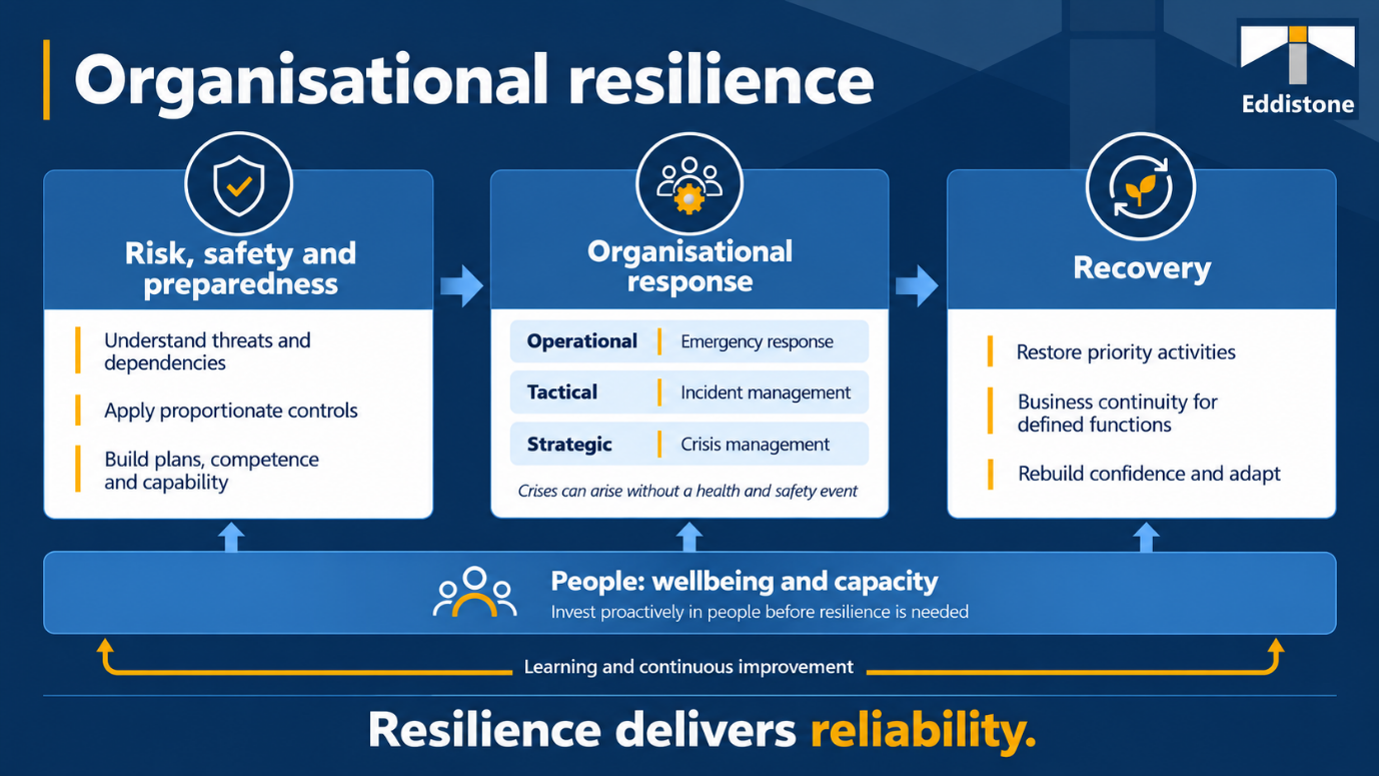
We understand that resilience connects risk, safety and preparedness with coordinated organisational response and structured recovery. These elements form a business cycle, which, to be effective, should be supported by leadership, clear responsibilities and practical capability.
The first area blends risk, safety and preparedness for reasonably foreseeable and/or known scenarios. Organisations need to understand their threats, vulnerabilities and dependencies, establish proportionate controls and prepare for situations that could challenge normal operations. This includes competent people, usable plans, reliable resources and training that tests decisions under pressure. Preparedness turns documented intentions into an operational capability, providing confidence that arrangements will work when required.
Organisational response operates at three connected levels; emergency, incident and crisis. At the operational level, emergency response addresses immediate conditions, protects life and limits harm. At the tactical level, incident management coordinates resources, establishes priorities and supports delivery across affected activities. At the strategic level, crisis management addresses the wider consequences for the organisation, its stakeholders, reputation and future. Each level needs defined authority, communication and a shared understanding of the situation.
Not every crisis needs an emergency
A crisis may develop from an emergency or incident, but the crisis arrangements must also accommodate situations with no initial health and safety event. Top of the list (no surprises) is successful cyber disruption, quickly followed by financial pressures, allegations, supply chain failure, loss of leadership or stakeholder confidence, all of which can threaten organisational objectives without an operational emergency. Crisis capability therefore needs to extend beyond the escalation of safety arrangements. It requires leaders to interpret uncertainty, make decisions and manage competing demands while protecting trust and organisational viability.
Recovery planning establishes how the organisation extends support into the future and moves back towards its normal sustainable operating position. Business continuity forms part of this area, addressing specific business functions or work streams, their dependencies and the arrangements needed to resume activities, in priority. Wider recovery also considers rebuilding confidence, resolving consequences and adapting to changed circumstances. Recovery should dovetail with the response, identifying clear ownership and setting realistic priorities.
Eddistone helps organisations bring these areas together through consultancy, training and exercising. We overlay our own all-scenario systematic approaches for each level of response, then the preparedness into something you can actually use under pressure.
Organisations should aim to build resilience capability for reasonably foreseeable risk and scenarios. Prevention informs preparedness, response supports recovery and learning strengthens future performance. By dividing responsibility organisations can efficiently manage disruption with clarity and confidence.
 Resilience places additional demands on people; this requires a proactive investment in their capacity and their wellbeing. Long before a disruption hits. It’s a bit like insurance. You get the cover in advance, but it only proves it’s worth when something goes wrong. People need headroom, clarity, and support in advance, so that when the organisation needs resilience in action, it’s ready.
By encouraging Risk and Safety to share equal place in workplace conversations, by empowering your team, Resilience becomes embedded in everyday decisions and can be demonstrated when your organisation needs it.